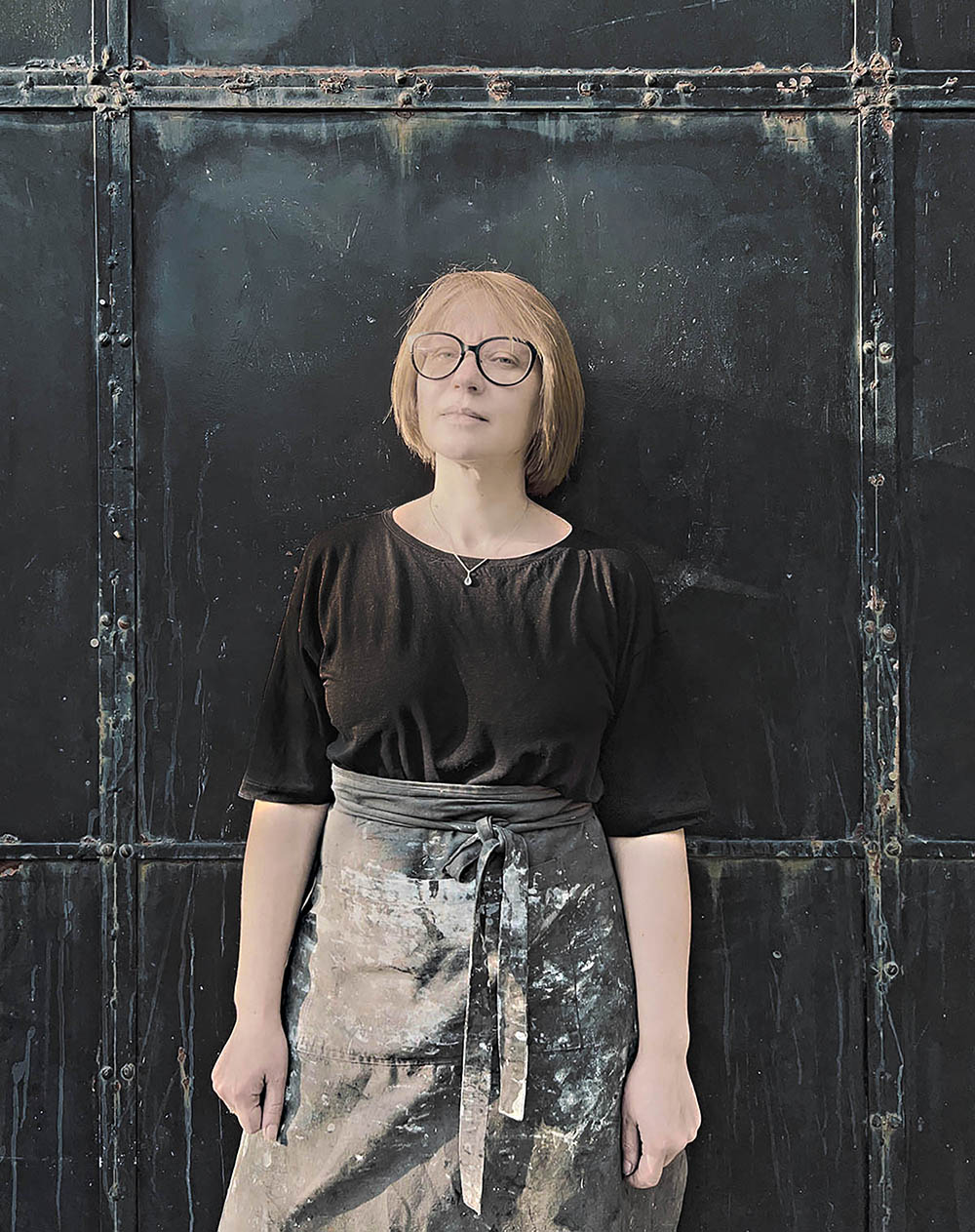
An artist making prints. thinker. Material Veta Gorner Printmaking

ABOUT.

An artist making prints


Veta Gorner is a multidisciplinary artist based in the UK. She works across various media but her main interests and specialism are printmaking and graphic arts. Drawing on her background in architecture, design, and publishing, she approaches her work with both the discipline of a maker and the curiosity of a cultural analyst.

Her prints are as much about process as they are about outcome — a dialogue between control and chance, structure and spontaneity runs through both. This duality gives her work a distinctive presence, at once meticulously crafted and deeply expressive.

Visual poet


Veta’s work often examines changes humans endure and bring into being — structures, relationscapes, connection, shadows, cuts and lines recur as concerns across otherwise very different bodies of work.

Growing up in the 1980s and across a number of cultures, she is interested in both technological and ethical concerns. The unease and tensions that follow, between the personal and the social, frequently feature in her philosophically driven and materially conscious work, as she strives to animate the century-old art of print with new approaches to its process, and bring a little dash of curiosity and grace into the world.

Material thinker


Zinc, copper, and mesh each hold a mark differently — choosing between them already decides part of what a print can become. Years of paying attention to what these materials do taught etching and silkscreen far more than any classroom.

Freehand drawing and digital manipulation combine regularly too, because both make real demands on the material at hand. Handling old technique and new tools as equally serious is where the originality actually emerges. Printmaking keeps changing regardless of any one artist’s part in it — craft, observation, and invention worked together.

Devoted to graphic arts


Veta studied and worked in visual professions for over 30 years. Having made the UK her home 25 years ago, she set up her studio not long after, and never really stopped working from it. Decades of shows have followed — print fairs, the Royal Academy Summer Exhibition, solo shows at Eames Fine Art — one project leading into the next before the last one had properly finished.

In 2016 she was elected a full Fellow of the Royal Society of Painter-Printmakers. She has since completed a full-time Master of Research in Art: Theory and Philosophy at Central Saint Martins, UAL, with distinction — the same restlessness that started this, still running.

INTERVIEW.

Q: What motivates you and why printmaking?

A: I am fascinated by the expressive nature of human motion and its dialogue with space. I construct and engineer my forms instead of drawing directly from life and build suggestions of meaning into my compositions and visual provocations.

As much as I am concerned with the conceptual side of my work, I am interested in stretching the creative possibilities of the materials I work with. Whether it is a zinc, steel, or copper plate matrixes, which I treat as a sculptural medium, or semi-transparent paper, which I use to layer individual images to create an illusion of depth or references of shifts in time, I strive to meticulously choose the materials that would be a joy for the senses and a thrill for the mind. Beyond printmaking, I paint, draw, sculpt, make, and design.

But I always come back to print.

My work is a celebration of life and a reflection upon its highs and lows and tensions in between. It is concerned not only with physical structure but also with the thoughts and emotions that move us into action. It is also about how the environments we inhabit shape and change us.

My work is about life, which is movement.

Q: When did you first employ printmaking as part of your creativity and what drew you to the medium?

A: Making prints, in most simple terms, is a method of producing works of graphic art. Both “graphic arts” and “independent” have to make sense in the equation of one’s life ahead of setting sail for the future of a studio artist.

I made my first original print at twenty-eight. In the years preceding, I was trained in architecture and worked in advertising and publishing, and I loved and loathed aspects of both professions. As often happens, life adjusted context and aspirations. Motherhood and moving to a new country precipitated the change, so I became who I am now – an artist with a printing press. Initially, the decision to go independent was guided by a survival instinct. It was my way of claiming a place in the world at a time when the sense of self was under threat from sweeping social pressures.

A few things appealed to me from the get-go. I appreciated printmaking as a communicational art form – a print is often born with an audience in mind – and I love that aspect of addressing the work to viewers. Furthermore, printmaking plugs an artist into the vast and fascinating cultural heritage, this gave me a feeling of instant belonging. Additionally, there are creative gains and rituals, the flow of the process. Out of which a sense of devotion to the craft had sprung.

Q: What are your favoured methods for creating your work in print and why?

A: The indirect process of making prints appeals to me greatly. Before the plates turn into impressions, there is the fascination of developing their form and function in one’s mind. There is a tug and pull between intellectual and unselfconscious. The complex processes of printmaking are a succession of actions and reactions – it is human, and thrilling.

Naturally, I delight in freehand drawing and how a line translates from a plate to a print. The other side of me is fascinated with what an eye perceives as tone: the representation of light and space.

Graphic arts are, by nature, reductive and assume functions of a language: with functions, rules, and perception mechanisms. But these mechanisms are open-ended. The rules are there yet not there – you can utilize existing ones or make up your own. There is also an option of breaking the rules entirely.

Artists (especially in graphics) tend to follow pathways afforded by the mediums we work in. But the creative quest is to find tangible, engaging, and original ways to share ideas. Art above all is an illusion materialized, with as many illusions as there are minds to read them.

And as I intuitively lean toward storytelling in my work, I find myself endlessly negotiating between the methods and materials, something I believe will never end.

Q: What do you hope to convey in your work?

A: Intrigue and wonder. A seed of thought. To stir and to comfort. Bestow a connection.  Art is the language that helps us “paint” emotions, and communicate something for which we have no language, yet. On either side of the emotional spectrum, there are no words/no logic, so my work is a perception mechanism that helps me deal with the potency and vastness of these imagined possibilities.

Q: Who and what has inspired your creativity (artists, art movements, experience)?

A: A search to find avenues of expressing perceivable yet nonverbal binds all visual artists together and makes them kindred spirits. Art, the way I see it, is not a consecutive line of eras and names. It is an abundant field: self-ruling, everlasting, and free to work on –  pick your tools and have a go. As long as humanity is there, there will be some form of art, it is a state of pure being first. An artefact is simply a proof of that state and as such a proof of life.

The most inspiring art for me is nudging to think and feel, the one open to questioning and not devoid of playfulness.  I am equally interested in Roman sculpture, medieval manuscripts, orthodox icons, renaissance drawing, Japanese woodblock, Colour Field, generative computer art, and many more ways humans explored, recorded and shared their experiences. It is impossible to feel lonely in art.

Veta Gorner Printmaking

BACKGROUND, PUBLICATIONS & SHOWS.

PROFESSIONAL EXPERIENCE

Currently working from her own studio near Stamford, UK (set up in 2014) and her second studio in Northern Sweden.

Fellow of the Royal Society of Painter-Printmakers (RE, since 2016)

(2003-9) Member of the Greenwich Printmakers Association (www.greenwich-printmakers.org.uk).

(2003) Associate member at the PRINTSPACE Studio/Gallery (2 Bear Gardens, SE1, London).

(2002) Studied printmaking at Morley College, London.

Previous (1996-2002) experience includes working for various publishing and advertising companies and clients as art-director, graphic designer and illustrator.


EDUCATION

Master of Research in Art: Theory and Philosophy (Distinction), Central Saint Martins, University of the Arts London (2024–2026).

(1993-8) St. Petersburg State Artistic and Industrial Academy [(formerly pre-1998) “Muhina School of Industrial Arts”, St. Petersburg].  Degree in Interior Design and Architecture.


FELLOWSHIPS & AWARDS

Visiting Guest Artist Fellowship & Residency, Scuola Internazionale di Grafica, Venice, September 2026.


SHOWS : SOLO & NAMED

“Hymns”, Eames Fine Art, 2023

“Moving Parts”, Eames Fine Art, 2021

“Out Brief Candle”, Eames Fine Art, 2020

“Common Place”, collaborative project, Eames Fine Art Printroom, 2020

“Printmakers in Lockdown”, group show, Bankside Gallery, 2020

“Age of Loneliness”, multi-print installation, Woolwich Contemporary Print Fair, 2019

“Masters”, Bankside Gallery, 2018 and 2019

“Originals”, Bankside Gallery, 2018 and 2019

“Masters: Etching”, curated by Norman Ackroyd, 2016


SHOWS — RECURRING

Royal Academy Summer Exhibition — 2018, 2019, 2020, 2023, 2024

Woolwich Contemporary Print Fair, London — 2018–2025

International Original Print Exhibition (formerly National Original Printmaking Exhibition), Bankside Gallery, London — 2016–2025

London Original Print Fair, London — 2016–2025


COLLECTIONS

Work in collections of  Victoria & Albert Museum, University of Wales, Aberystwyth; Royal Society of Printmakers Diploma Collection.


PUBLICATIONS & PRESS

Reframing Women Printmakers, ed. PL Henderson, Aurora Metro Books, 2025 — contributor.

“A Clockwork Diorama”, David Harsent (poetry) with fifteen copperplate engravings by Veta Gorner, Fine Press Poetry, UK, 2024 — limited letterpress edition.

Studio feature, Pressing Matters Magazine, Issue 12, 2020.

Feature, Printmaking Today, vol. 29, 2020.

Interview, Bankside Gallery Magazine, 2016.